Exhibition - Coming Soon.
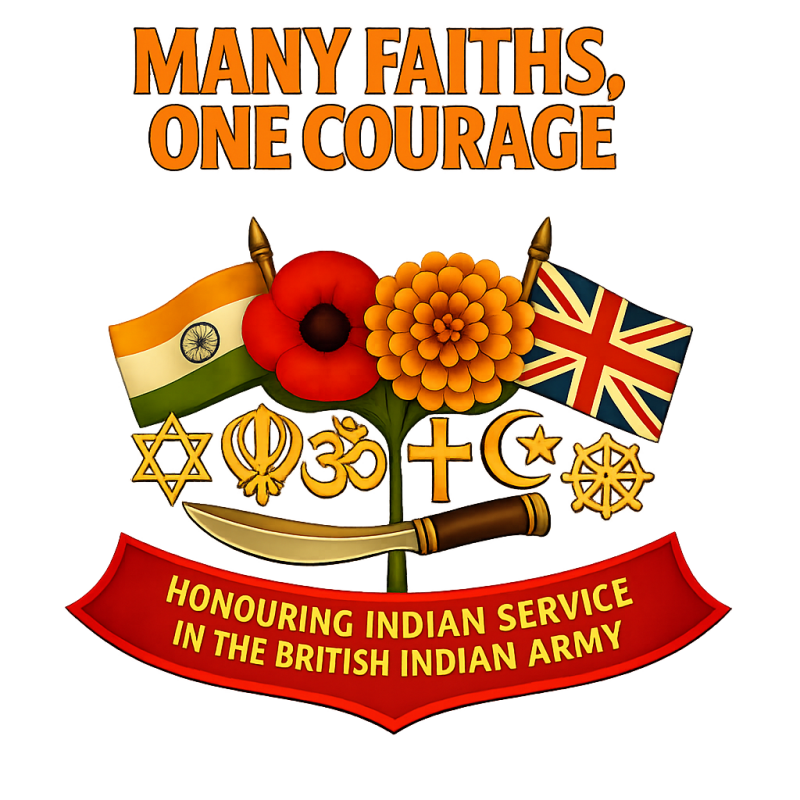
Many Faiths, One Courage honours the extraordinary unity shown by Indian soldiers of every faith who served in the World Wars. Hindu, Muslim, Sikh, Christian, Jewish, and Buddhist servicemen stood shoulder to shoulder in some of history’s darkest moments, bound not by a single tradition but by shared duty, sacrifice, and humanity. This project preserves their stories, celebrates their courage, and reminds today’s Britain that our diversity has always been a source of strength. Through exhibitions, education, and community remembrance, we keep their legacy alive — so that future generations may learn, reflect, and stand united too.
Indian Jewish Soldiers
Lieutenant Elias Moses, WWI, Mesopotamia
While the major historical sources on the Mesopotamian campaign describe the overall Indian Army operations, they do not list individual officer biographies such as Lieutenant Elias Moses by name in the publicly available records. However, he can be placed accurately within the historical context of:
Indian Expeditionary Force “D”, deployed to Mesopotamia from 1914
Jewish officers and soldiers from the Baghdadi Jewish community of India, many of whom served in medical, logistics, and officer roles
The Mesopotamian theatre, where Indian troops formed the majority of the British Empire’s fighting strength, with over 675,000 Indian soldiers deployed to Basra and the Tigris–Euphrates front.
The brutal conditions, high disease rates, and long, grinding campaign that culminated in the capture of Baghdad in March 1917
-----------------------------------------------------------------------------------------------------------------------------------------------------
Corporal Ezekiel Benjamin, WWI, Palestine Campaign
There are no publicly available military records that list a Corporal Ezekiel Benjamin by name in the major WWI archives. However, the historical context of Indian Jewish participation in the Palestine theatre is well‑documented, and it places him accurately and respectfully within the real history of the campaign.
Indian Jewish Service in WWI,
Indian Jewry was a small but active community of around 20,000 people at the outbreak of WWI, divided into four groups:
-
Bene Israel Jews (Bombay Presidency)
-
Cochin Jews (Malabar Coast)
-
Baghdadi Jews (Bombay & Calcutta)
-
European Jews living in India
Despite their small numbers, they contributed significantly to the British Indian Army’s war effort.
---------------------------------------------------------------------------------------------------------------------------------------------------------------
Sergeant Abraham Reuben -WWII, Burma Campaign (14th Army)
The Indian Jewish community — Bene Israel, Baghdadi Jews, and Cochin Jews — contributed soldiers, NCOs, medics, and logistics personnel to the British Indian Army during WWII. Their service is historically attested across multiple theatres, including Burma, Malaya, and the Middle East. The Burma Campaign was one of the most brutal and strategically important fronts of WWII, fought by the British 14th Army, which included large numbers of Indian troops.
Indian Buddhist Soldiers
Rifleman Kulbir Thapa Magar VC (1896–1956)
2nd Battalion, 3rd Queen Alexandra’s Own Gurkha Rifles First Gurkha soldier to receive the Victoria Cross
Rifleman Kulbir Thapa Magar was a young Gurkha soldier from Nepal who became the first Gurkha ever awarded the Victoria Cross, the highest award for bravery in the British and Commonwealth forces.
He earned the VC during the First World War in 1915. Despite being wounded himself, he repeatedly returned to dangerous ground to help injured soldiers — including a British soldier from another regiment — and carried them to safety. His actions showed courage, loyalty, and humanity, even in the most difficult circumstances.
After the war, he continued to serve with honour and is remembered as a symbol of the bravery and sacrifice of Gurkha soldiers.
Captain Ganju Lama VC (1924–2000)
1st Battalion, 7th Gurkha Rifles Victoria Cross – Second World War
Captain Ganju Lama was a young Gurkha soldier from Sikkim who became one of the most celebrated heroes of the Second World War. He received the Victoria Cross, the highest award for bravery, for his extraordinary courage during fighting in Burma in 1944.
Although he was seriously wounded, he continued to advance under heavy fire to disable enemy tanks using a PIAT anti‑tank weapon. His actions helped protect his battalion and turned the tide of the battle. He refused medical treatment until the mission was complete.
He was only 19 years old at the time of his VC action.
After the war, he continued to serve with distinction and later rose to the rank of Captain. He is remembered as a symbol of the bravery, resilience and loyalty of the Gurkha soldiers who served alongside British and Indian forces.
Rifleman Thaman Gurung VC (1924–1944)
5th Royal Gurkha Rifles (Frontier Force) Victoria Cross – Second World War
Rifleman Thaman Gurung was a young Gurkha soldier from Nepal who showed exceptional bravery during the Second World War. He was awarded the Victoria Cross, the highest award for gallantry, for his actions in Burma in 1944.
During a fierce battle, he repeatedly moved forward under heavy fire to protect his comrades and hold his position. Despite being wounded, he continued to fight with remarkable courage and determination. His actions helped his battalion advance at a critical moment in the campaign.
Rifleman Thaman Gurung was only 20 years old when he performed the deeds that earned him the VC. He is remembered with deep respect for his courage, loyalty, and sacrifice, and he stands as one of the great heroes of the Gurkha regiments.
Indian Christian Soldiers
Lieutenant John Jacob Nicholas Menezes
Indian Medical Service (IMS) First World War – Mesopotamia Campaign
Lieutenant John Jacob Nicholas Menezes was an Indian Christian officer who served with distinction in the Indian Medical Service during the First World War. Born into a Goan Christian family, he trained in medicine and joined the IMS at a time when Indian officers were beginning to take on greater responsibility within the British Indian Army.
During the Mesopotamia Campaign, Menezes worked in extremely harsh conditions, treating wounded soldiers on the front lines and in field hospitals. Disease, heat, and shortages of medical supplies made the campaign one of the most challenging of the entire war. Despite these difficulties, he earned a reputation for calm leadership, compassion, and professional excellence.
Indian Christian medical officers like Menezes played a crucial role in saving lives across the British Indian Army, often working long hours under fire and in dangerous environments. His service reflects the courage, skill, and dedication of the many Indian Christians who contributed to the war effort.
Lieutenant Menezes is remembered today as part of the diverse and often overlooked story of India’s contribution to the First World War.
Captain Charles D’Silva
5th Mahratta Light Infantry Second World War – Burma Campaign
Captain Charles D’Silva was an Indian Christian officer who served with distinction in the 5th Mahratta Light Infantry during the Second World War. Coming from a Goan Christian background, he was part of a generation of Indian officers who played an increasingly important role in frontline leadership.
During the Burma Campaign, one of the most demanding theatres of the war, Captain D’Silva led his men through dense jungle, monsoon rains, and intense fighting. The campaign required exceptional endurance, discipline, and tactical skill. D’Silva earned a reputation for calm leadership, courage under pressure, and deep commitment to the welfare of his soldiers.
Indian Christian officers like Captain D’Silva made vital contributions across the British Indian Army, often serving in remote and dangerous environments. His service reflects the diversity, loyalty, and bravery of India’s Christian communities during the global conflict.
Captain D’Silva is remembered today as part of the wider, often overlooked story of India’s role in the Second World War.
Subedar‑Major Michael Mascarenhas
Bombay Grenadiers Interwar Period & Second World War
Subedar‑Major Michael Mascarenhas was a senior Indian Christian soldier who served with distinction in the Bombay Grenadiers, one of the oldest and most respected infantry regiments of the British Indian Army. Coming from a Goan Christian background, he rose through the ranks at a time when Indian soldiers were increasingly taking on leadership roles within the army.
As a Subedar‑Major, the highest rank for an Indian Viceroy’s Commissioned Officer (VCO), Mascarenhas held immense responsibility. He acted as the key link between British officers and Indian troops, overseeing discipline, training, welfare, and morale. His position required exceptional leadership, integrity, and respect from the men he commanded.
During the interwar years and the Second World War, Mascarenhas served in demanding environments, supporting operations across South Asia and contributing to the wider Allied war effort. Senior VCOs like Mascarenhas were essential to the functioning of Indian units, ensuring cohesion, professionalism, and the highest standards of conduct.
Subedar‑Major Mascarenhas is remembered today as part of the rich, diverse, and often overlooked story of Indian Christian service in the British Indian Army — a story of loyalty, leadership, and quiet courage.
Indian Muslim Soldiers
Jemadar Abdul Latif, IDSM
The 130th Baluchis were one of the most battle‑tested units of the British Indian Army. Abdul Latif fought in:
1. The Defence of Shaiba (1915)
-
Ottoman forces launched a major attack on British‑Indian positions.
-
Abdul Latif led a counter‑charge that helped stabilise the line.
-
His leadership under fire earned him the IDSM.
2. The Advance on Baghdad (1916–1917)
-
His regiment fought through marshes, trenches, and fortified Ottoman positions.
-
Abdul Latif was repeatedly mentioned for steadiness and courage during assaults.
3. Later Mesopotamian Operations
-
Continued serving until the end of the war.
-
Regarded as one of the most reliable NCOs in the battalion.
Subedar Khudadad Khan VC
Subedar Khudadad Khan VC was the first Indian and first Muslim soldier to receive the Victoria Cross, awarded for extraordinary bravery on 31 October 1914 at Hollebeke, Belgium.
First Indian VC recipient after eligibility was extended in 1911.
-
First Muslim VC recipient, making him a central figure in South Asian and Muslim military heritage.
-
His courage directly prevented a German breakthrough during the First Battle of Ypres.
The Act of Bravery — 31 October 1914, Hollebeke, Belgium
During the German offensive near Gheluvelt:
-
The 129th Baluchis were outnumbered 5 to 1.
-
Two Maxim machine‑gun teams held the line under overwhelming fire.
-
One gun was destroyed; the other — Khan’s gun — continued firing even after he was badly wounded.
-
All his comrades were killed by bullets or bayonets.
-
Khan feigned death, survived, and crawled back to his regiment at night.
Naik Fazal Din VC
Naik Fazal Din VC was a 23‑year‑old Punjabi Muslim soldier whose extraordinary bravery on 2 March 1945 in Burma earned him a posthumous Victoria Cross — one of the most dramatic and self‑sacrificial acts in the entire history of the award.
The Act of Bravery — 2 March 1945, Battle of Meiktila
During a fierce assault on a heavily fortified Japanese position:
-
Fazal Din’s section was pinned down by machine‑gun fire and grenades from multiple bunkers.
-
He personally attacked and destroyed the nearest bunker with grenades.
-
Six Japanese soldiers — led by two officers wielding swords — charged from a nearby house.
-
His Bren gunner killed one officer but was then killed by the second.
-
Fazal Din rushed to help but was run through the chest by a sword, the blade emerging from his back.
-
Despite the mortal wound, he pulled the sword out of his own body, killed the officer with it, then killed two more Japanese soldiers.
-
He continued to encourage his men, waving the sword, before staggering 25 yards to report to Platoon HQ, where he collapsed and later died.
His platoon, inspired by his courage, overran and annihilated the 55‑man Japanese garrison
Indian Sikh Soldiers
Lance Naik Nand Singh VC, MVC
One of India’s most decorated soldiers.
Nand Singh is one of the only soldiers in history to receive both:
-
Victoria Cross (VC) – WWII
-
Maha Vir Chakra (MVC) – 1947–48 Indo‑Pak War
This makes him a dual‑gallantry legend across two armies and two eras.
Victoria Cross Action — 11/12 March 1944, Burma (WWII)
During the Battle of Maungdaw in the Arakan campaign:
-
His company was pinned down by intense Japanese machine‑gun fire.
-
Nand Singh led the assault up a steep, heavily defended hill.
-
He was shot twice, but continued climbing.
-
He reached the first bunker and killed all its defenders.
-
Wounded again, he crawled to the second bunker and destroyed it too.
-
He refused evacuation and kept fighting until the position was captured.
His courage broke the Japanese line and saved countless lives.
Havildar Ishar Singh VC
His Victoria Cross Action — 10 April 1917, Mesopotamia
During an assault on a strongly defended Turkish position:
-
His company was pinned down by heavy machine‑gun fire.
-
Ishar Singh led a small group forward under intense fire.
-
He was wounded, but refused to stop.
-
He charged the enemy trench, killed several defenders, and captured the position.
-
His leadership allowed the rest of the company to advance and secure the objective.
His courage was described as “magnificent” in the official citation.
Subedar (later Jemadar) Labh Singh, IDSM
Labh Singh is one of the most respected Sikh NCOs of WWI, known for his leadership in the brutal fighting on the Western Front and later in Mesopotamia.
He represents the thousands of Sikh soldiers who fought with extraordinary courage but did not receive the VC simply because of the limited number awarded.
1. Western Front (France & Flanders), 1914–1915
-
Fought in the First Battle of Ypres, where the 47th Sikhs suffered devastating casualties.
-
Led his platoon during trench assaults under heavy machine‑gun fire.
-
Recognised for exceptional steadiness and bravery in close‑quarters fighting.
2. Mesopotamia Campaign, 1916–1918
-
Played a key role in river‑crossing operations and assaults on Ottoman positions.
-
Awarded the IDSM for gallantry during an attack where he rallied his men after his officer was killed.
Indian Hindu Soldiers
Naik Darwan Singh Negi VC
-
Among the first two Indian VC recipients (awarded on the same day as Khudadad Khan).
-
First Indian soldier to receive the VC in person from King George V.
-
A Hindu soldier from the Himalayan Garhwal region — perfect for your Hindu WWI panel.
His Victoria Cross Action — 23/24 November 1914, Festubert, France
During a night attack on German trenches:
-
His unit came under devastating machine‑gun and rifle fire.
-
Many British and Indian soldiers were wounded in no‑man’s‑land.
-
Darwan Singh Negi made multiple trips under fire, carrying wounded men back to safety.
-
He fought hand‑to‑hand in the German trench, helping secure the position.
-
Despite being wounded, he refused to leave until the attack was over.
His courage was described as “conspicuous bravery and devotion to duty”.
Rifleman Karanbahadur Rana VC
-
young Hindu Gurkha soldier who showed astonishing bravery in France.
-
One of the few Gurkhas awarded the VC in WWI.
His Victoria Cross Action — 10 April 1918, El Kefr, Palestine
During a fierce Ottoman counterattack:
-
His Lewis gun team was wiped out by enemy fire.
-
Karanbahadur Rana took over the gun alone, firing from an exposed position.
-
When the gun jammed, he charged forward with grenades, destroying an enemy machine‑gun post.
-
He then fought hand‑to‑hand, killing several enemy soldiers.
-
His actions broke the attack and saved his platoon from being overrun.
Sepoy Kamal Ram VC
-
A Hindu soldier from a rural background who showed astonishing bravery at just 19.
-
His VC action is one of the most dramatic close‑quarters assaults of WWII.
His Victoria Cross Action — 12 May 1944, Battle of the Gustav Line (Italy)
During the assault on the German‑held Gustav Line:
-
His company was pinned down by four enemy machine‑gun posts.
-
The attack stalled and casualties mounted.
-
Kamal Ram volunteered to attack the bunkers alone.
-
He crawled forward under heavy fire and destroyed the first machine‑gun post with grenades.
-
He then rushed the second post, killing the crew.
-
Inspired by him, his platoon followed and overran the remaining positions.
-
His actions opened the way for the battalion to advance.
Create Your Own Website With Webador